How a few weeks of “prehab” before prostate‑cancer treatment can put you on the front foot for recovery.
September is Prostate Cancer Awareness Month
If you or someone you love has just been told that prostatectomy surgery or radiotherapy lies ahead, there is often a 4-6 week gap between diagnosis and treatment. Instead of watching the calendar tick down, you can use that time to train the very muscles and fitness systems that treatment is about to challenge. This forward‑looking approach is called prehabilitation or “prehab”.
What exactly is prehab?
Think of prehab as a personalised program that happens in the weeks before your operation or radiation starts, with the goal of building up your physical and mental resources to help optimise your post-op recovery.
Prehab before prostatectomy should ideally take a holistic, biopsychosocial approach, incorporating psychological support for mental well-being and stress management; nutritional support to optimise surgical healing; and exercises to improve physical functioning, and boost the pelvic floor muscles to minimise post-prostatectomy incontinence.

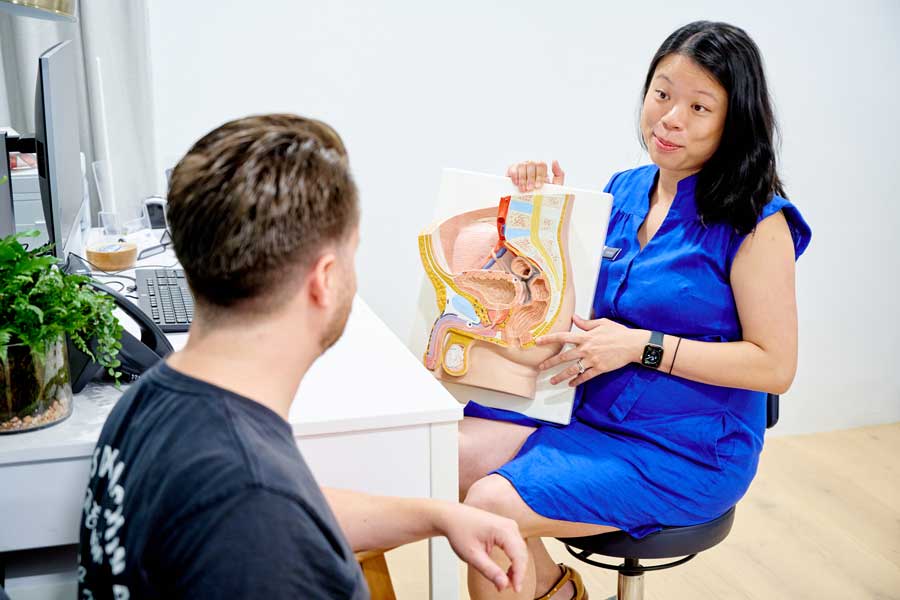
From a physiotherapy point of view, your first prehab appointment will involve thorough history-taking to work out whether you have any pre-existing concerns to do with your bladder function (eg. urgency, frequency, voiding difficulties like poor flow or emptying, or post-micturition dribbling), bowel function (eg. constipation), and sexual function (eg. erectile dysfunction).
The goal is then to get you very familiar with your pelvic floor muscles- an area to which you may never have been acquainted- which are very important in the control of your bladder and for erectile function!
This may happen by using biofeedback (eg. verbal feedback or using an ultrasound on your perineum to give you a visual of what your muscles are doing to ensure you are activating them correctly).
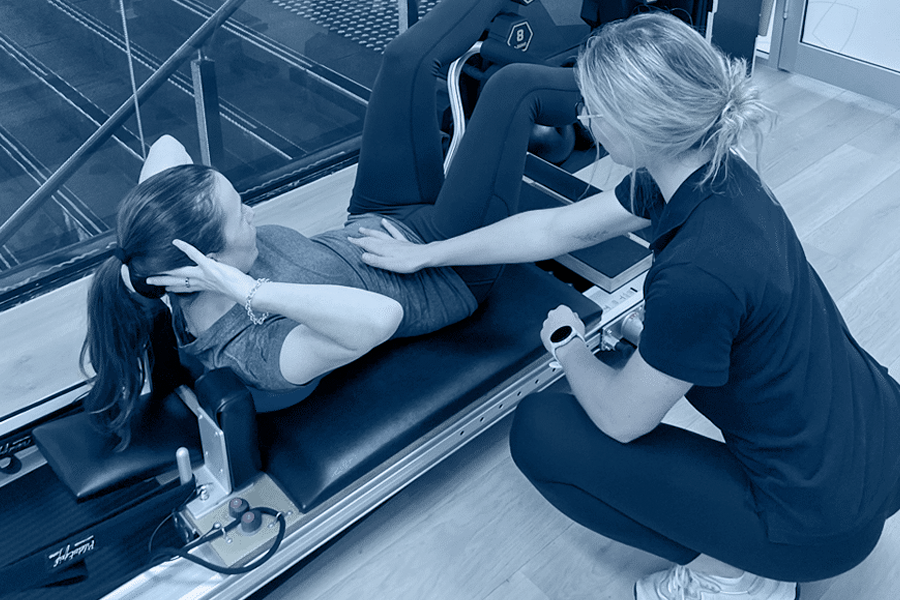
At this stage, it is important to get the brain-muscle connection going and to get your pelvic floor muscles in the best state possible before surgery. You will be given an individualised pelvic floor muscle training program and other whole-body exercises to keep your heart, lungs and muscles in shape.
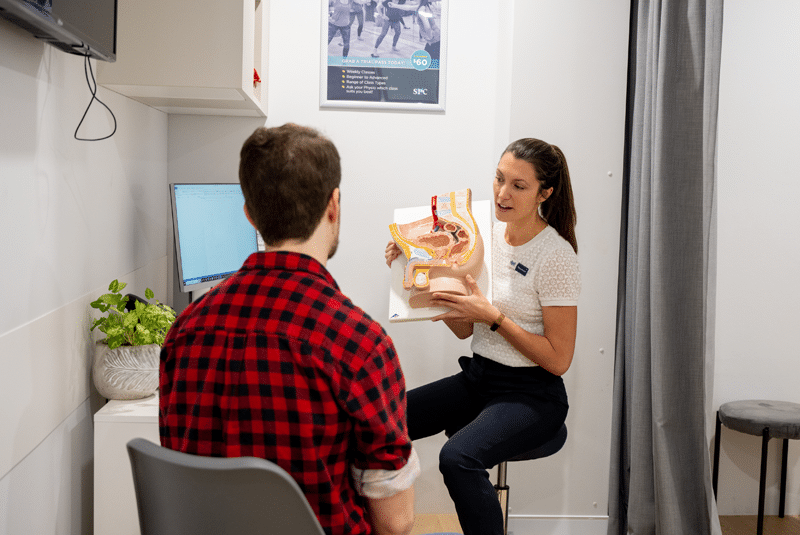
Pelvic‑floor 101: finding the right muscles
- Sit or lie comfortably. Imagine trying to stop yourself passing urine mid‑flow—that gentle lift is the pelvic floor.
- You could also try this in standing in front of a mirror so your anatomy is visible. Imagine trying to stop the flow of urine or imagine shortening the shaft of your penis. You may be able to see some in-drawing at the base of your penis or the testicles lifting.
- You should not see your tummy bulge or grip excessively, or see your buttocks tighten.
- If you’re unsure, definitely book in with a pelvic health physiotherapist – we can check and help!
What does the research say about prehab?
Recent Studies Found: A 2023 review of 12 studies found men who started PFMT before prostatectomy were 39% less likely to be incontinent at 3 months after surgery (Zhou et al, 2023)
What it means for you: Earlier return to confidence in social and work life.
Recent Studies Found: A 2025 meta‑analysis showed PFMT + biofeedback decreased urinary leakage significantly through the first year after surgery compared to controls (Brea-Gomez et al, 2025)
What it means for you: The extra guidance seems to lock in long‑term gains.
Recent Studies Found: An Australian trial had men do 6 weeks of gym based cardio & weights before surgery. They boosted leg strength pre-surgery more than the post-op rehab-only group (17.2 kg vs 6.7kg); lost almost no speed on a 400 m walk after their op, while the “rehab only” group did, and had significantly less pre-surgery fatigue (Singh et al, 2023).
What it means for you: Exercise before surgery helps to substantially improve strength and function, which may help to buffer the effects of surgery.
Recent Studies Found: Across more than 20 prostate cancer prehab studies, no serious injuries or surgery delays were reported (Zhou et al, 2023; Singh et al, 2023)
What it means for you: You’re unlikely to harm yourself or postpone treatment by exercising smartly.
A 4‑week “prep list” you can start tomorrow
Week 1
Learn the muscle: tighten as if stopping urine stream. Hold 5 secs, relax 5 secs × 10, 3 times/day.
Move your body
20 minute brisk walk every second day.
Mind & Fuel
Write three recovery goals; tick them off weekly.
Week 2
Continue pelvic floor squeezes, aiming to increase your holds to 8 secs. Try biofeedback with a pelvic physio.
Move your body
Light weights or resistance band for legs, chest, back (2 sets of 10).
Mind & Fuel
Swap one processed snack for a protein rich option.
Week 3
Aim for 8-10 sec holds if able, 10 reps x3 sets. Add “The Knack”: squeeze just before you cough or stand up.
Move your body
Progress walks to 30 min; keep weights but add one extra set.
Mind & Fuel
5 minute deep breathing exercises at bedtime to help calm the nervous system.
Week 4
Move your body
Taper exercise 3 days before surgery/radiation starts.
Mind & Fuel
Finalise a post‑treatment support plan with family.
(Adjust pace/weights to stay in the “moderate” effort zone—you should be slightly puffed but able to talk.)
What does the research say about prehab?
Yes. Think of prehab as laying the foundation; rehab builds the house. Keep practising your pelvic floor squeezes once your catheter is removed post-op, and restart general exercise once your doctor gives you clearance.
The bottom line
Prehabilitation isn’t just another item on the to do list—it’s a head start on healing. Just a month of targeted pelvic floor practice and sensible exercise can mean:
• Fewer leaks in the early weeks after surgery
• More strength to get moving sooner
• A calmer, better prepared mindset
If you’re waiting for prostate cancer treatment, talk to your care team/ physiotherapist about turning that wait into action. Your future self will thank you!
- For more information on post-prostatectomy recovery advice, see:
Everything you need to know about recovering from a prostatectomy - The best support services after prostate surgery
For support and resources, the Prostate Cancer Foundation of Australia is an invaluable organisation: https://www.pcfa.org.au/
(Information in this article is for general education. Always follow the advice of your urologist and physiotherapist for your personal circumstances.)